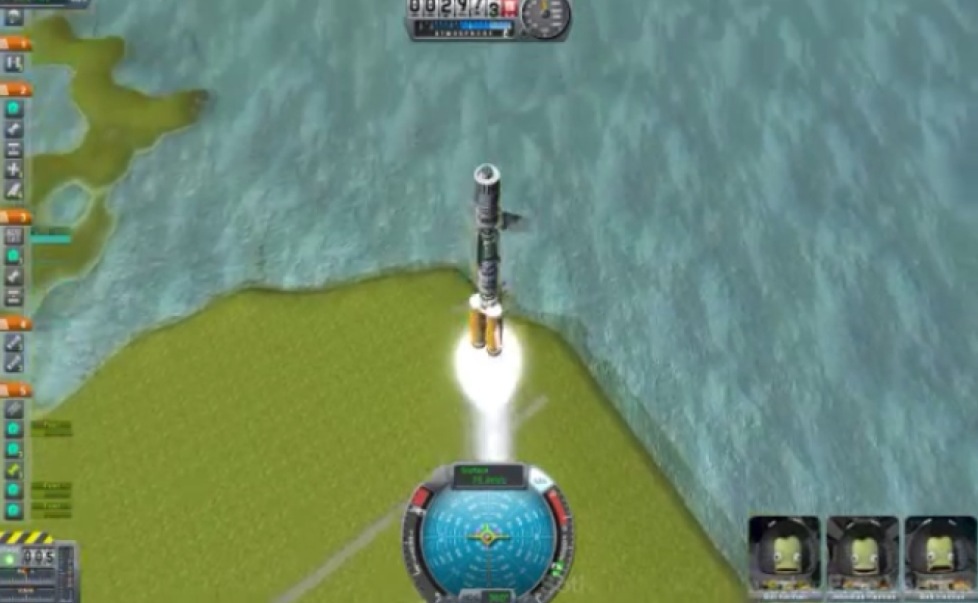
 Previously I was talking about how difficult a mission to the Mun can prove to be in Kerbal Space Program. It's not just that things can unpredictably go wrong - we are dealing with gigantic rockets, after all - it's also that things can be very difficult to correct when they do go
awry.
But let's not dwell on my foreshadowing of this write-up! I'm sure everything will come good!
Right?
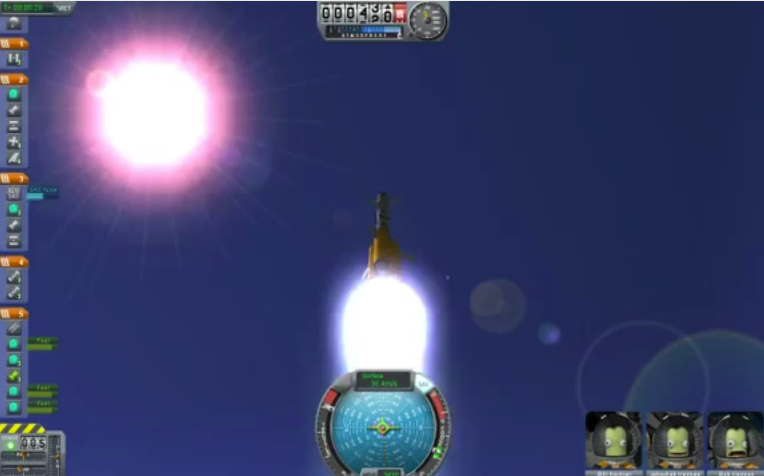
Damn right!
We're off to the moon, cats and kittens, and there ain't nuthin' going to stop me making this a successful mission! Well, except possible rocket failure or slamming into the moon's surface at 3,000 meters per second. But hey, I thought we'd agreed not to foreshadow? Not that any of that stuff is going to happen, of course.
The way up into space goes swimmingly. As I approach 20,000 meters above the planet with the rocket handling well, I begin to tilt at 270°. Here's what a rocket flying at near 20,000 meters tilting towards a 270° axis looks like:
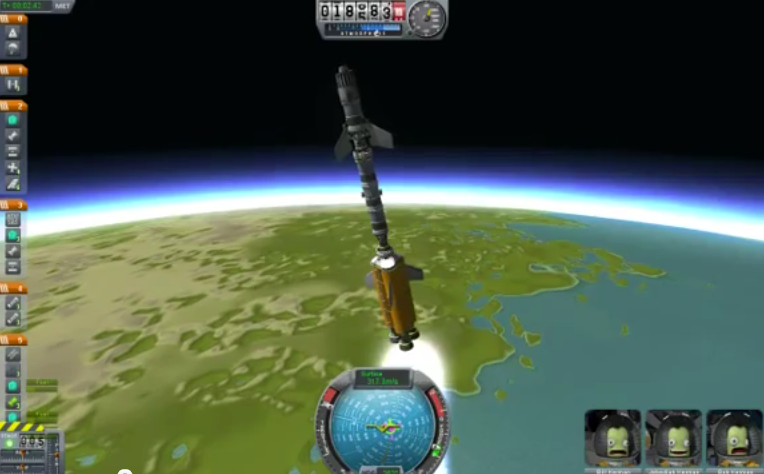 I carry on doing that until the first stage (the stack of orange rockets) runs out of juice. The ship is sailing quite admirably, and gives me no real trouble on the controllability front. At 85k meters I tilt fully horizontal and begin trading vertical speed for lateral speed and start to make my way across the planet in such a way that I'll never land - I'll fall past the horizon and into a circular orbit.
And it's official - we've reached space. Our fuel is looking healthy, as is our trajectory. But of course, this is just the start and while leaving the gravitational pull of our home planet is a pretty cool trick, we've got a whole dimension of difficulty ahead of us.
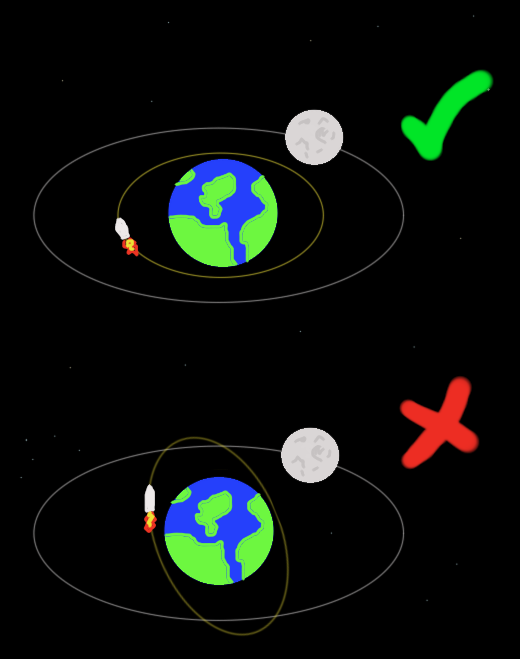
I manage to stabilise an orbit around the planet. It's entirely in parallel with the Mun's orbit around us, so I won't have to come at it from some filthy angle.
 I turn off the engines for now and enjoy the quiet. There's a specific point at which I need to fire up again in order to correctly meet the Mun on its own domain, but that point is not for a while.
I fly around the planet at an incredible speed - over 2,000 meters per second - but it feels like I'm floating slowly across the void with the ocean glistening below.
It's the calm before the storm.
The moon disappears beneath the horizon behind me. This is the point at which I need to fire up, extend my orbit outwards and approach the moon head on. I ditch the second rocket stage which is now spent and continue onwards with my crew sitting on a tiny booster with fins. How adorable!
But not time to be all 'awwwww' right now, as I've got to concentrate on not overshooting my desired trajectory as it'll take the last of my fuel to correct it if I do. This, my friends, is the storm.
Ah. Actually, that went pretty okay. Just right, in fact - all we've got to do now is sit back and enjoy the ride across the translunar void before we begin the tricky job of tightly circling the Mun in a fly-by manoeuvre.
So I guess this bit is the real calm before the storm. Ignore the previous calm. That was more of a bland pause.
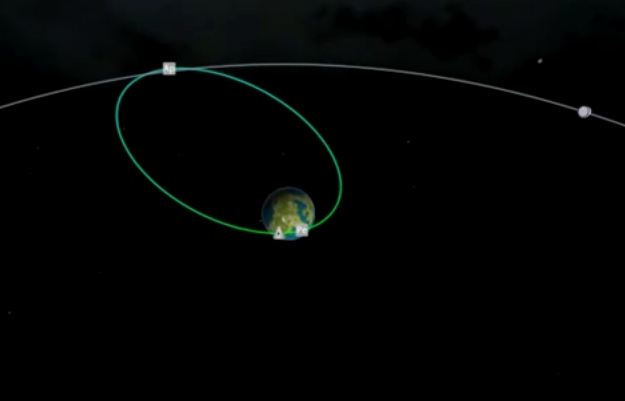 So this is the situation. My ship - the little triangle at the bottom - is travelling around the now-extended orbit to the left. Hopefully we'll meet the moon as it swings in from the right along its own orbit (the grey line). Actually, I need to adjust this so I head a bit further, otherwise I'm going to skirt along the Mun's orbital path and slam into it at full throttle. Not a good idea.
I wait until I'm a little further out until I thrust forward for about ten seconds. This extends my orbital path, which now looks like this:
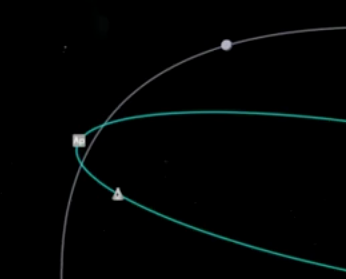 Using a special branch of rocket science which falls under the disciplinary umbrella of 'pure guesswork', I calculate that our ship will slow down as it reaches the top of the arc while the Mun, since it is in a uniform orbit, will carry on at the same speed. This should mean that as I reach my furthest point away from Kearth (marked by the grey square) the Mun will be right under me. It'll continue on its merry way, I'll fly above and around it, then we'll all be back home in time to watch Antiques Roadshow.
There are a couple of other possibilities, of course. I could come in too 'low' (a relative term in space) which will result in the Mun's gravity pulling me into freefall towards its surface. That is as bad as it sounds when you only have a small tank of fuel.
The other, very real, possibility is that I get way too close to the Mun as I circle it and it throws my trajectory way out of whack. You've seen that bit in Armageddon where they slingshot around the moon and Steve Buscemi is all like 'No waaaaay!', right? Right.
I have no idea what the outcome will be. In this game, I mean, not Armageddon. Seen that movie loads of times. Love it.
The problem is that while the game brilliantly models Newtonian physics, one thing it can't compute is the combined gravitational affects of two celestial bodies at the same time. To be fair to the Kerbal Space Program developers, neither can astrophysicists.
The upshot of that is the Mun won't have an affect on us until we get closer - I'm orbiting the planet Kearth and all of a sudden we'll 'snap' onto the Mun.
Until that happens, I have no idea if this is going to work.
I wait.
And wait.
And then...
... ohshitohshitohshit we're flying straight towards the Mun.
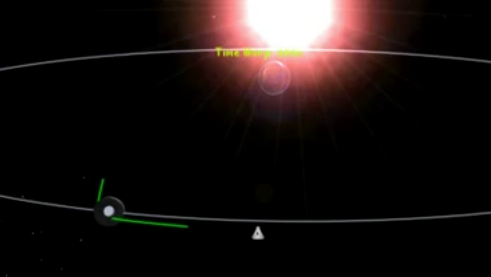 I reach the top of that arc too soon and the Mun hasn't caught up yet. My ship, at the bottom, is heading towards the left and the Mun is barrelling towards the right. Without emergency intervention, I'll travel along that green line. If the Mun wasn't solid, I'd go straight through it. But it is solid, of course, and trying to go through it would only see me progress about ten feet into the dusty surface.
Hmmm. How to correct this? I'm flustered and can't remember what the logic is here in order to adjust the orbit in the right way. Am I supposed to speed directly away from Kearth? Away from the Mun? To the left/right of either or possibly both?
Oh, nuts to it. I fire the rockets and try every single direction possible, carefully watching how it affects the green line. A-ha! Got it...
... not much fuel left, but I hope we'll naturally be going in a vaguely-homeward direction once we swing around the other side.
Wow, you guys!
I made it! We've flying over the moon!
(Images enhanced for brightness since the dark side of the moon is notoriously dim. Uploading videos to Youtube in 240 dpi and expecting to get descent screenshots from them afterwards is also a bit dim):
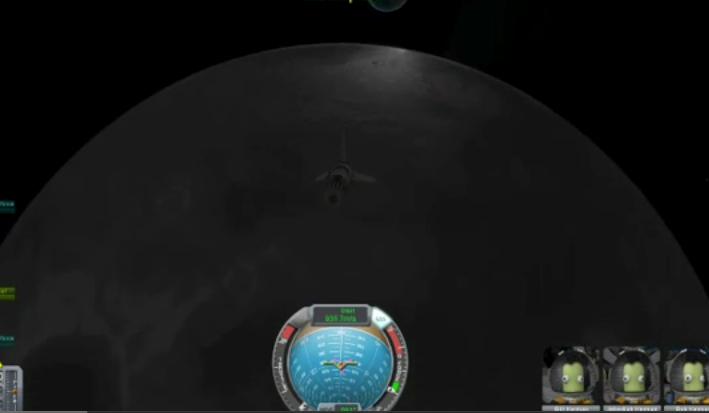
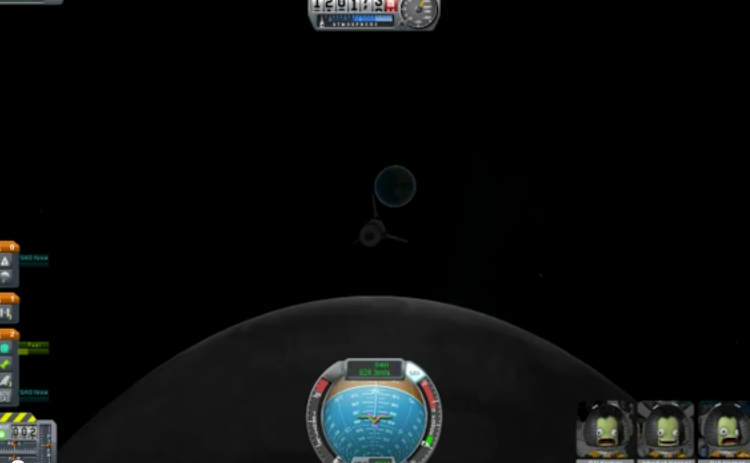 I'm elated, but the Kerbals look nonplussed in the first screenshot and downright horrified in the second. Whatever, guys - let's get you home.
No sooner do I announce this that they seem to perk up. I'm also even happier than I was during our Munar blackout, because I manage to navigate our course back to Kearth with relative ease and get us on track just before the fuel situation becomes critical.
Silhouetting the sun, it looks like it'll be nighttime where we land. That doesn't make any difference, of course - when we try and land on the Mun in the next mission, I'll want to land on the light side as it's hard to set a lander down when you can't see the slopes and cliffs. Here, we'll just be ejecting the empty tanks and releasing the parachute when we enter the atmosphere. Job done.
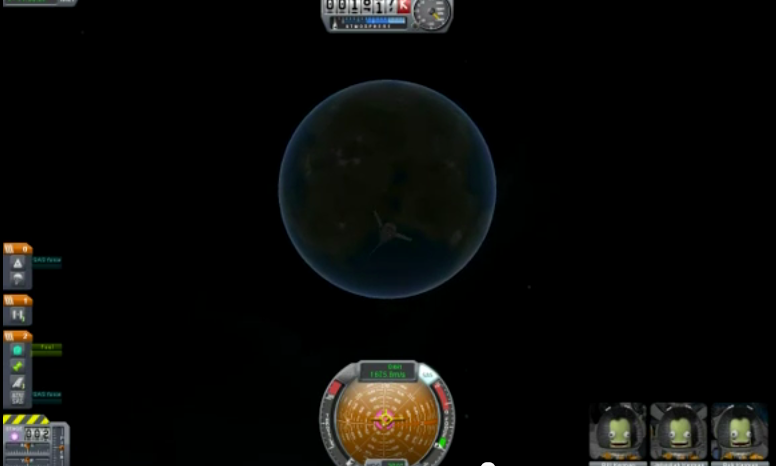
All I have to do is hit the space bar a couple of times when we're approaching land. Unless I wander off without pausing the game at this critical moment to have a nap, which I'm obviously not going to do, we're basically home safe.
Hah, and you guys thought I was going to crash into the moon! Oh ye of little faith.
Although I am kinda sleepy. No! Focus.
We come in fast. Drawn by the planet's massive gravity pull, the ship speeds up to over 3,000 meters per second by the time we hit the atmosphere. The air begins to howl around us as we enter the stratosphere - slight at first, but becoming a dull roar before too long. The capsule rapidly decelerates, but is still coming in at a lightning rate. I figure it'll be wise to deploy the parachute now in order to get us to a safe speed even quicker.
I figure wrong.
Travelling at well over a kilometer per second, the cloth parachute doesn't have a damned chance. It flies out of the crew capsule and is instantly ripped off by the extreme drag generated by our speed.
I can't believe my eyes.
That yellow thing currently disappearing above us was our parachute. Our parachute. We kinda needed that...
Bob starts screaming. So does Bill. Even Jebediah, who is usually unflappable, begins screaming. I scream.
There is literally nothing I can do for my men as they speed towards the side of a rocky mountain. I fire the engines in an attempt to slow them down, but I only get about five seconds of burn before the fuel's up. At least it reduces the risk of explosion - perhaps the empty tank will act as a crumple zone and save the crew capsule?
Time will tell, and it will speak in a rather hurried manner.
9,000 meters...
 1,600 meters...
 600 meters and yes I do appreciate that the quality of these images is so low that I might as well not bother...
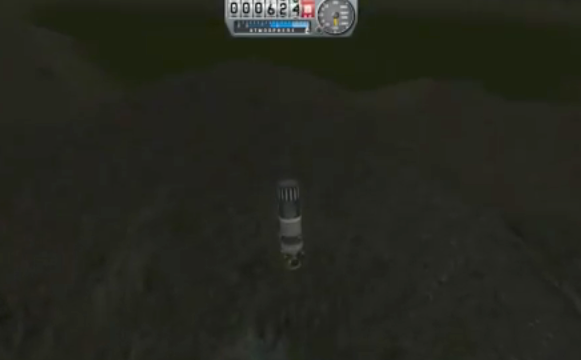 470 meters and for some bizarre reason my Kerbals seem surprisingly chipper about the whole situation. In two seconds' time, they'll be taking their inane grin with them to the afterlife...
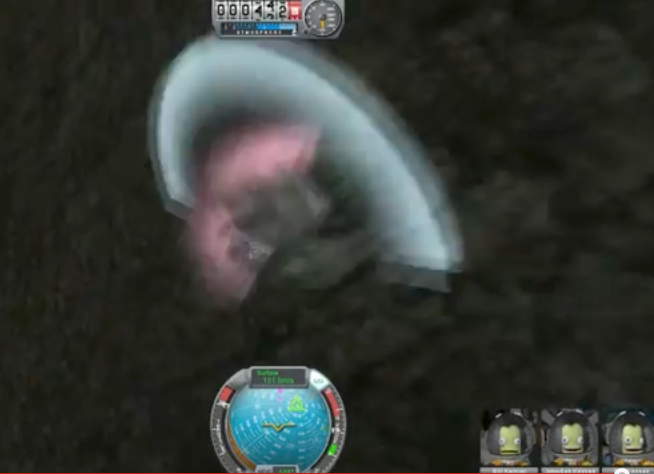
The rocket slams into the side of the mountain.
One millisecond after it collides, this is the final image of the doomed Kerbals before the transmission and their lives are violently taken away from ironmanmode.com:
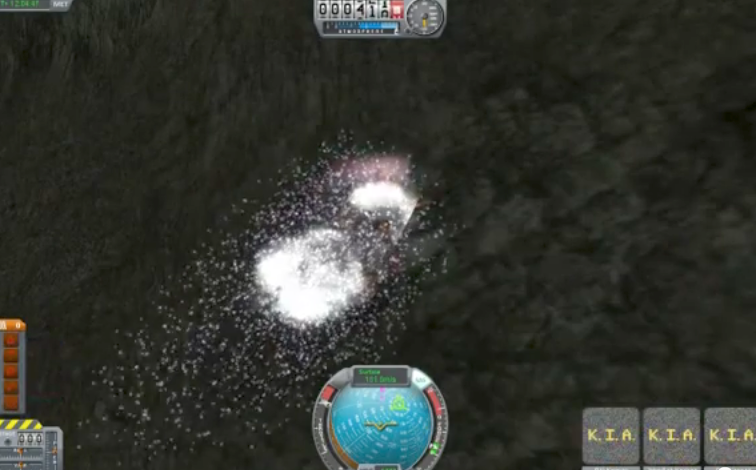 ... and it's all over.
As dictated by the rules of Iron Man Mode, this signifies the end of my Kerbal Space Program adventure and this blog.
Personally, I'm surprised we didn't meet catastrophic failure earlier and I'd like to thank anyone who has made it this far for reading.
I shall leave you with this fine sketch from Mitchell and Webb, which provides a good conclusion to what has truly been a superb adventure: